
No, the two are quite different. Only some refugees are stateless. Refugees are generally able to retain and prove their nationality, although they may still face risks of statelessness if their documents are lost or destroyed, or if national archives are compromised. Refugees are people who have had to flee their country because of safety concerns, while most stateless people are minorities or native populations in their own homeland, often in the country where they were born and continue to reside permanently.
Due to how stateless people face serious challenges in acquiring travel documents, and in having these documents respected in freedom of movement, being able to leave the conflict-torn country and gaining refugee status is a rare privilege among stateless individuals.
Much of the answer is based on the difference and debates over de facto versus de jure statelessness; and on whether those debates are even useful. When a person lacks legal identification and has no means of acquiring or re-establishing it, that person is effectively stateless, or de facto stateless. Nationality is a critical part of legal identification, not the other way around. Factual nationality and belonging to a territory does not automatically translate to legal nationality and belonging.
The World Bank has estimated that hundreds of millions of people have no legal identity; earlier ID4D estimates placed the number at around one billion, while newer estimates put it at more than 800 million. According to these newer reports, this difference in estimates is due to narrowing of methodology rather than progress of addressing the issue.
These figures do not account for people who possess some inferior form of legal identification, such as alien passports, sub-citizenships, stateless-person documents, or other documents marked with non-nationality designations such as XXA, XXB, XXC, XXO, or XXX.
Yes, there are uncountable millions of stateless people in the world. They are uncountable due to how data is heavily reliant on the ‘good faith’ and cooperation of state actors that cause and maintain mass statelessness. According to UNHCR, at least 22 countries that are known to have mass statelessness do not have reliable data.
Where mass statelessness is produced by design and malicious intent, accurate data is practically impossible to gather. In such cases, the very systems responsible for creating statelessness may also obscure, deny, or manipulate the evidence of its existence and scale. Where mass statelessness arises instead from incompetence, administrative neglect, oversight, or defects in nationality legislation, state authorities may still be reluctant to engage openly with the issue, since doing so can require admitting serious legal and institutional shortcomings.
On the rare occasion a stateless person is able to leave own territory where they are made stateless, there is also reluctance to recognise the existence of statelessness in the host states, for fear of ‘pull factor’ and obligations. That fear itself suggests that state actors may be aware of the scale of the issue: that statelessness affects far more than several million people.
Important to note: people are stateless from the day they experience it, not from the day some state officially recognises that experience for what it is and acknowledges what it has done or failed to do.
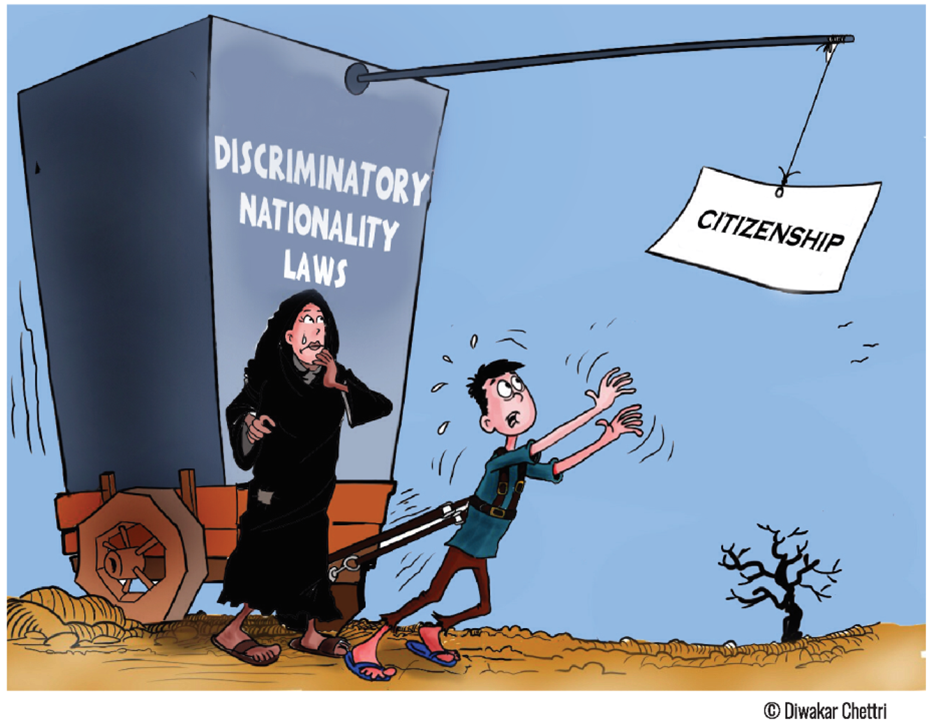
Stateless people most commonly become stateless for who they are rather than for what they have done. Discrimination is one of the leading causes of statelessness, especially when states exclude ethnic, racial, religious, linguistic, or gender-based groups from citizenship through nationality laws or administrative practice. Minorities are particularly vulnerable, and discriminatory nationality laws can leave entire populations stateless. In twenty-four countries women are not allowed to pass on their nationality, leading to many children being born stateless to this day.
As long as governance fails to function rationally and remains affected by institutional deficiencies, corruption or abuses of political power, statelessness will persist. Scapegoating, racism, religious nationalism, and similar forces can contribute to statelessness by shaping citizenship laws, birth registration systems, denationalisation policies, border changes, and documentation requirements.
Other common causes of statelessness include technical gaps in nationality laws, precarious migration, state succession leading to legal instability, state conflicts and wars, deprivation of nationality, and punitive measures taken against people for political dissent or opposition.
Statelessness can affect any people at any place and time. It knows no borders. The notion that statelessness does not happen in the ‘first world’ is ironically tied to an archaic discriminatory notion that Western states are more ‘civilised’ than the rest of the world and would not cause such an injustice to its own people. European history, to this day, harshly proves otherwise:
Germany, Austria, Greece, Italy, Greece, Turkey, Ukraine, Russia, Belarus, Slovenia, Czechoslovakia, Poland, Romania, countries in the Baltics and the Balkans, have all caused mass statelessness in the last century, intentionally or not. Some maintain statelessness on their territory to this day or initiated new cases (eg, Belarus). Other states like the United Kingdom, Spain, the Netherlands, Belgium have caused mass statelessness tied to their colonial past.
Territoriality, what does matter is the difference between jus soli and jus sanguinis principles to nationality. Countries with a jus soli principle for nationality, such as the case for most of the countries in the Americas, tend to avoid statelessness better. Although this is not entirely fool-proof, as has been recently illustrated in the Dominican Republic, Venezuela, and Nicaragua.
To some extent, yes. The effectiveness of that assistance depends on whether UN bodies are able to fulfil their mandates; and whether they are sufficiently connected to the affected individuals and communities to accurately perceive the problem and its potential solutions.
The UN’s work on statelessness is constrained by an inherent institutional contradiction: it is an organisation composed of states, which themselves are responsible for creating and perpetuating statelessness. Agencies such as UNHCR can advocate for legal and policy reform, support identification and protection efforts, and facilitate dialogue with governments. However, UNHCR recognises that it is underfunded, understaffed, and under-qualified to handle statelessness work.
Low public awareness adds another obstacle. Because statelessness receives relatively little attention or public pressure, it is frequently deprioritised in comparison with other humanitarian and human-rights issues. As a result, UN engagement can provide important support and occasionally contribute to meaningful change, but it remains structurally constrained, with very limited practical impact.
Not at all. In fact, stateless people are among the most vulnerable populations, exposed to such risks as arbitrary detention, unwarranted discrimination, extortion, and other abuses by public authorities and malicious actors such as criminals and human traffickers. Without a recognised nationality, stateless individuals may lack the legal protection, documentation, and other essential support available to citizens, making even basic rights difficult to exercise in practice. As Hannah Arendt famously observed, nationality often functions as “the right to have rights”: although human rights are universal in principle, access to them is still mediated through citizenship and belonging to a state.
This is something that stateless people tend to hear as a response to their bleak situation. There is no such citizenship. Some have suggested a concept of a regionally-based citizenship, like that in the EU, can be an answer to some forms of statelessness. However, as it stands today, granting of citizenship and nationality is entirely under jurisdiction of individual states.
Factual ties, ancestry, identity, and a genuine sense of belonging may count for little unless they are affirmed by the state through legal recognition of nationality. Such affirmations are not always based on objective or rational criteria. They depend heavily on the political authorities currently in power, and how they handle the state’s monopoly over legal identification and the formal determination of citizenship, nationality, and belonging.
There are many reasons, depending on the form and circumstances of statelessness. Quite often, the same discrimination that causes statelessness also prevents stateless people from resolving it. Unless that underlying discrimination is addressed, naturalisation may remain inaccessible in practice.
Gaps in the law can also leave stateless people without a clear route to nationality or even secure residence status. Where naturalisation is formally available, the process may still involve requirements that stateless people cannot realistically meet, such as lawful residence, recognised identity documents, proof of income, high language proficiency (particularly difficult for the elderly), or high application fees. In some cases, where systemic discrimination is entrenched, these barriers may deliberately be maintained to exclude particular stateless populations from acquiring nationality.